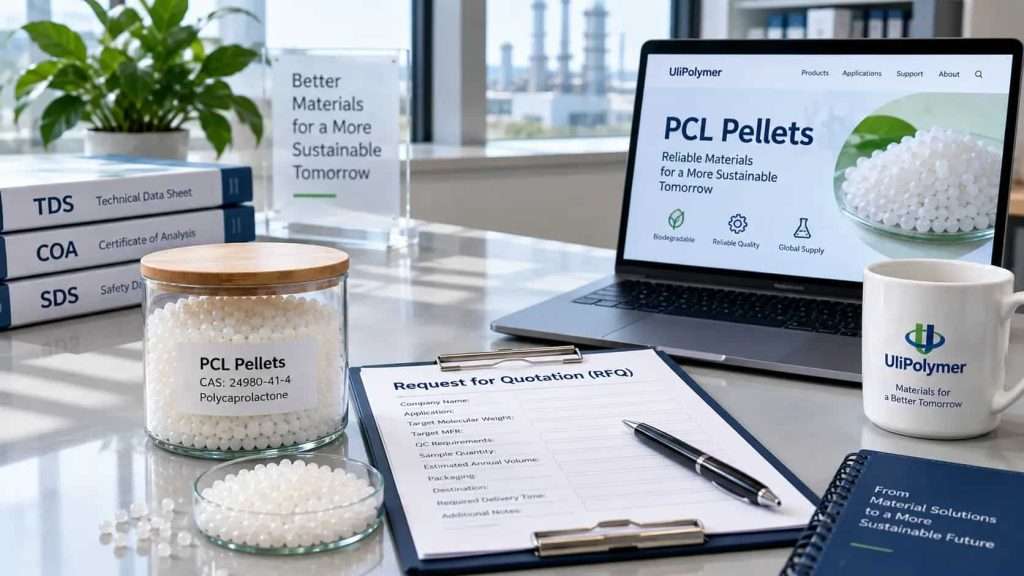
Two PCL pellet grades can share the same polymer name and CAS number while differing in molecular weight, melt-flow behavior and other processing-related specifications. These differences can influence melt behavior, mixing, processing consistency and the performance of the finished material.
For a buyer or process engineer, “I need PCL” is not enough information to get a usable recommendation. A supplier cannot match a grade to a requirement until the processing route — extrusion, compounding, or molding — and the target end-use are defined. This guide walks through that selection logic: how to read molecular weight and melt flow together, which quality parameters matter before a trial, how to evaluate PCL pellets for each processing route, and how to move from a sample to a qualified commercial grade.
Extrusion, compounding and molding require different material-selection priorities.
Molecular weight should not be used as the only grade-selection parameter.
Sample trials, batch data and acceptance criteria support commercial approval.
Start With the Processing Route, Not Just the PCL Name
Before comparing molecular weight or melt flow numbers, define how the material will actually be processed. The same PCL pellet can be a good fit for one route and a poor fit for another, so the processing route should be established first — grade selection follows from it, not the other way around.
Extrusion
- Pellet feeding consistency
- Target molecular weight range
- Melt flow rate versus line and die requirement
- Thermal exposure during processing
- Downstream film, sheet, filament or profile requirement
Compounding
- Blend partner
- Compatibility with PCL
- Blend ratio under evaluation
- Additives or fillers
- Dispersion and batch stability
Injection or Thermoplastic Molding
- Melt-flow requirement
- Part geometry
- Thermal behavior
- Cooling and solidification
- Finished-part performance
Defining the route first turns a vague inquiry into a specific technical conversation, and it is the starting point for everything that follows in PCL pellet selection.
Molecular Weight and Melt Flow Should Be Evaluated Together
Why Molecular Weight Matters
Molecular weight influences how PCL behaves in the melt state, how it responds to shear and thermal exposure during processing, and — depending on the formulation and process — how the finished material may perform mechanically. Two pellets with the same CAS number are not automatically the same processing grade if their molecular weight differs; this is why molecular weight is the first specification to confirm, not an afterthought.
Why Melt Flow Rate Matters
Melt flow rate (MFR) is a practical, comparative indicator that buyers use to judge how a PCL grade will run on their specific equipment. It reflects how the material flows under defined temperature and load conditions, making it a useful comparative parameter for melt processing, mold filling and process consistency — factors that molecular weight alone does not fully describe.
Why Molecular Weight Alone Is Not Enough
A single molecular weight figure does not tell a processor everything needed to qualify a grade. Moisture level, melt flow, batch-to-batch consistency, and compatibility with any blend partner all interact with molecular weight to determine actual processing behavior.
| Buyer Question | Parameter to Check | Why It Matters |
|---|---|---|
| Will this grade extrude consistently? | Molecular weight + MFR | Helps assess melt viscosity and processing consistency |
| Will PCL blend evenly with my base polymer? | MFR + moisture + compatibility data | Affects dispersion and process stability during compounding |
| Will the melt fill my mold geometry? | MFR + thermal behavior | Governs flow into cavities and cycle consistency |
| Is this batch equivalent to the one I qualified? | Current specification + batch COA | Confirms applicable batch-control parameters remain within the agreed specification |
Check Moisture, Acidity and Free Monomer Before a Processing Trial
Beyond molecular weight and melt flow, three additional parameters routinely appear on a PCL specification sheet and are worth reviewing before committing pellets to a trial run.
湿气
Residual moisture in PCL pellets can affect melt processing consistency and surface quality during extrusion or molding. It should be confirmed against the current COA during incoming material review.
酸度
Acidity is a batch-control parameter included in the PCL specification. Buyers qualifying a material should confirm the production batch remains within the agreed limit.
Free Monomer
Residual monomer content is another batch-specific figure worth checking when consistency between qualification samples and later commercial batches matters.
How to Evaluate PCL Pellets for Extrusion
Evaluating a PCL grade for extrusion is less about following a fixed recipe and more about confirming the material behaves predictably on the equipment being used.
- Pellet feeding consistency — whether pellets flow evenly through the hopper without bridging or segregation
- Target melt-flow range — whether the grade’s MFR fits the intended line speed and die configuration
- Thermal exposure and residence time — how long the material spends in the melt state
- Output appearance — surface finish, clarity or gel content depending on the product
- Downstream product requirements — what the final film, sheet or profile needs to deliver
- Blend partners or additives — if the extrusion process includes them
How to Evaluate PCL Pellets for Compounding
Compounding evaluation involves more variables than single-material extrusion or molding because the outcome depends on how PCL interacts with another polymer or additive system.
Identify the Blend Partner
PCL is commonly evaluated alongside other biodegradable polymers such as PLA, PBS or PBAT, as well as select conventional polymers, depending on the target application.
Define What PCL Is Expected to Change
In a blend, PCL may be evaluated for its potential contribution to flexibility, processability or overall mechanical balance. These outcomes are formulation-specific and should be treated as trial targets rather than guaranteed results.
Check Compatibility Before Scale-Up
- Dispersion quality between PCL and the blend partner
- Phase behavior
- Visual appearance and consistency
- Process stability
- Fit against the finished-property target
There is no universal blend ratio that applies across formulations. The correct range should be established through trial rather than assumed from a generic figure.
How to Evaluate PCL Pellets for Injection and Low-Temperature Molding
- Melt flow relative to part geometry
- Thermal behavior during heating and cooling
- Cooling and solidification behavior
- Appearance and dimensional result
- Finished mechanical requirement
- Production trial results
Specific mold temperatures, injection pressures and cycle parameters are equipment- and formulation-dependent and should be confirmed through an actual trial rather than applied as a fixed rule.
PCL Selection Matrix by Processing Route
| Processing Route | Priority Parameters | What to Confirm During Trial |
|---|---|---|
| Extrusion | Molecular weight, MFR, moisture | Feed stability, melt behavior, output consistency |
| Compounding | Molecular weight, MFR, compatibility | Dispersion, blend stability, process consistency |
| Injection Molding | MFR, thermal behavior | Mold filling, appearance, part performance |
| Film Processing | Molecular weight, melt behavior, compatibility | Film formation, flexibility, process behavior |
What Should You Test When the PCL Sample Arrives?
A sample is only useful if it is evaluated systematically. Treat the arrival of a PCL sample as the start of a qualification record, not just a material to run once.
Packaging, lot number, pellet appearance, quoted specification and COA.
Feeding, melt behavior, dispersion, visual consistency and process stability.
Target property, appearance, dimensional result and compatibility outcome.
COA, TDS, SDS and any required compliance documents.
For
industrial-grade PCL pellets
used in extrusion, compounding or molding trials, this documentation review allows a sample result to be traced back to a specific, verifiable batch rather than a general product description.
From Sample Trial to Commercial Grade Approval
What Information Should You Send Before Requesting a PCL Grade Recommendation?
A complete inquiry gets a faster, more accurate grade recommendation. The following information helps match a PCL grade to your process rather than generating a generic response.
| 信息 | Example |
|---|---|
| Processing route | Extrusion / compounding / molding |
| End product | Film / compound / molded part |
| Target molecular weight | If known |
| Required MFR | If known |
| Blend partner | PLA / PBS / PBAT / other |
| Additives / fillers | If applicable |
| Trial quantity | Sample requirement |
| Commercial quantity | Batch / monthly / annual estimate |
| Destination | Country |
| Documents required | COA / TDS / SDS / compliance |
PCL Pellet Selection Checklist
Frequently Asked Questions
Should I choose PCL pellets by molecular weight or melt flow rate?
Neither figure alone is sufficient. Molecular weight and melt flow rate should be reviewed together, along with moisture and compatibility data.
What information should I provide when requesting PCL for extrusion?
Share your processing route, end product, target molecular weight or MFR range if known, trial quantity and downstream performance requirements.
Can I evaluate PCL pellets with PLA, PBS or other polymers before bulk purchasing?
Yes. A laboratory- or pilot-scale compounding trial is a practical way to evaluate dispersion, compatibility and process stability before larger production.
Which PCL batch parameters should be reviewed before a production trial?
Review the declared molecular-weight grade against the applicable TDS and confirm MFR, moisture, acidity and free monomer against the relevant batch COA.
Should the commercial PCL specification match the sample used during qualification?
Yes. Commercial lots should be verified against the same specification basis as the sample that passed qualification.
Can I request a PCL sample before confirming a commercial order?
Yes. Sample quantities are typically available for technical evaluation and processing trials ahead of a commercial or bulk order decision.